Children are priceless treasures from God. As Muslims, we consider human life sacred, and that every child is a unique being, worthy of respect and dignity. Children are made to be loved, cherished, and provided with the opportunity to grow up in a healthy, happy environment.
Every child is precious in God’s eyes and deserves to be loved, nurtured, and honored with quality care, to enable them to develop their full potential.
It is indeed a God-given responsibility of every Muslim parent to impart to their children a deep appreciation, respect, and love for Allah, His Messenger, His Religion and the sacred principles contained therein.
We must, therefore, give utmost importance in the upbringing of our successors, by drawing upon lessons from the beloved Prophet s.a.w who has been the greatest role model for humanity throughout history, not just through his words which serves as a guidance for mankind, but also through his actions, which is a source of inspiration for many.
The Prophet’s personality was not merely exemplified for a specific period, generation, nation, religion or place. Rather, he is a lasting global symbol for all people, transcendent through time. The Prophet s.a.w said,
إِنَّ مِنْ أَكْمَلِ الْمُؤْمِنِينَ إِيمَانًا أَحْسَنُهُمْ خُلُقًا وَأَلْطَفُهُمْ بِأَهْلِهِ
“Indeed among the believers with the most complete faith is the one who is the best in conduct and the most kind to his family.”
(Sunan At-Tirmizi)
In Islam, our parents have rights upon us, and when we become parents ourselves, our children have rights upon us.
The key qualities every parent should strive to attain are epitomised by Prophet Muhammad s.a.w, who adopted the following non-exhaustive approaches:
1. Prophet Muhammad’s Love & Attention Towards Children
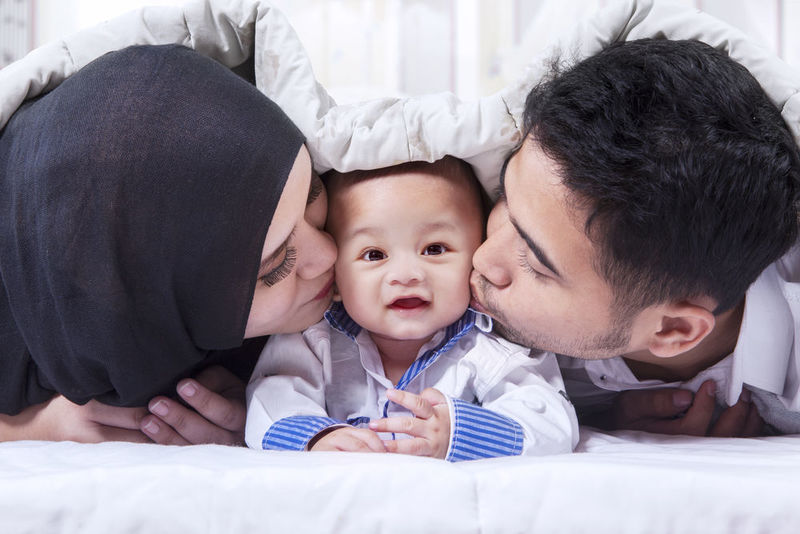
Needless to say, the Prophet’s s.a.w innate nature of being a mercy for all of God’s creations is undisputed. His mercy is unparalleled and indeed, his treatment of children, and not just his own progeny, is an example to us all. The Prophet s.a.w. would kiss and embrace children often, as an expression of his tender love and mercy towards them. In this hadith about children. Abu Huraira r.a. reported that al-Aqra’ bin Habis saw Allah’s Messenger s.a.w kissing Al-Hassan (the Prophet’s grandson). He (al-Aqra’) said: “I have ten children, but I have never kissed any of them”. Whereupon Allah’s Messenger s.a.w. replied:
إِنَّهُ مَنْ لاَ يَرْحَمْ لاَ يُرْحَمْ
He who does not show mercy (towards his children), no mercy would be shown to him.”
(Sahih Muslim)
He would also take an active interest in their lives, despite his busy schedule. For example, when the pet bird of a young child, Abu Umair, died, he went out of his way to try and console him.
عَنْ أَنَسِ بْنِ مَالِكٍ، قَالَ كَانَ رَسُولُ اللَّهِ صلى الله عليه وسلم يَدْخُلُ عَلَيْنَا وَلِي أَخٌ صَغِيرٌ يُكْنَى أَبَا عُمَيْرٍ وَكَانَ لَهُ نُغَرٌ يَلْعَبُ بِهِ فَمَاتَ فَدَخَلَ عَلَيْهِ النَّبِيُّ صلى الله عليه وسلم ذَاتَ يَوْمٍ فَرَآهُ حَزِينًا فَقَالَ مَا شَأْنُهُ. قَالُوا مَاتَ نُغَرُهُ فَقَالَ يَا أَبَا عُمَيْرٍ مَا فَعَلَ النُّغَيْرُ
Anas bin Malik r.a said: “The Messenger of Allah s.a.w used to come to visit us. I had a younger brother who was called Abu ‘Umair by nickname (kunyah). He had a sparrow which he played with, but it died. So one day the Prophet s.a.w came to see him and saw him grieving. He asked: ‘What is the matter with him?’ The people replied: ‘His sparrow has died.’ He (the Prophet s.a.w) then said: ‘Oh Abu ‘Umair! What has happened to the little sparrow?'”
(Sunan Abi Daud)
In this hadith, we see the example of the Prophet s.a.w. who goes out of his way to help a young child, whereas many adults would brush away from such a seemingly trivial situation. This kind of relationship can build trust, open communication, and validation for the child.
In today’s day and age, many parents are struggling to spend sufficient time with their children so it is vital that any time spent together is of the best quality. A combination of heartfelt playful activities, combined with loving conversations will provide security and comfort, thereby ensuring that a child has a healthy emotional development.
2. Prophet Muhammad’s patience with children

Anas ibn Malik was a young boy when he had the honour of serving the Prophet s.a.w. It is narrated from him that during his ten years of service, the Prophet s.a.w never said a word of impatience or rebuked him. Narrated by Anas r.a himself:
خَدَمْتُ النَّبِيَّ صلى الله عليه وسلم عَشْرَ سِنِينَ، فَمَا قَالَ لِي أُفٍّ. وَلاَ لِمَ صَنَعْتَ وَلاَ أَلاَّ صَنَعْتَ
“I served the Prophet s.a.w for ten years, and he never said to me, ‘Uff’ (a minor harsh word denoting impatience) and never blamed me by saying, “Why did you do so or why didn’t you do so?”
(Sahih Al-Bukhari)
A child is bound to err at times but we are to bear with it patiently, whilst advising and guiding them. We shouldn’t be constantly admonishing our young ones. Making supplications or dua for your children is also the prophetic way. It is reported that a parent’s supplications for one’s children are not rejected by Allah s.w.t.